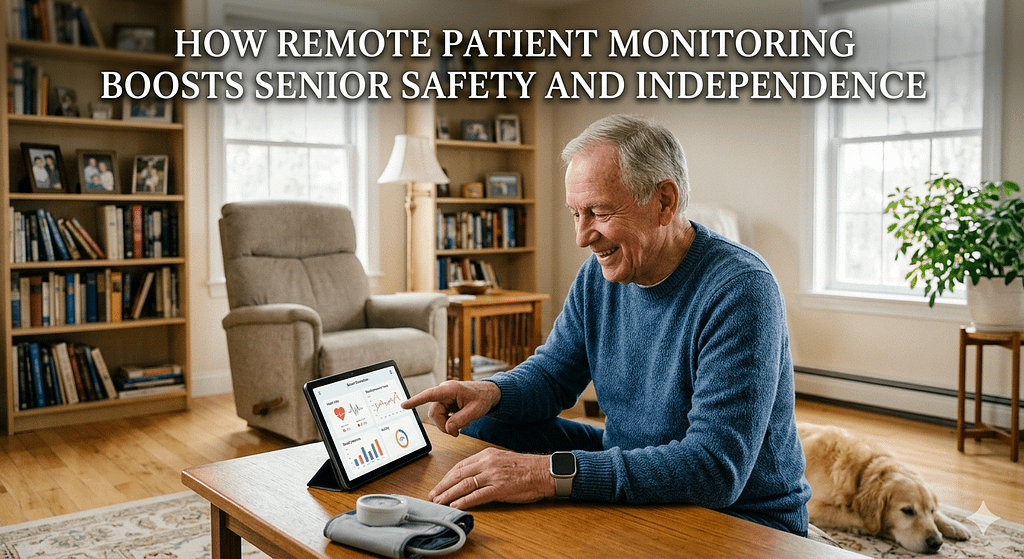
The desire to “age in place” is a universal sentiment among seniors, yet the challenges of chronic disease and mobility often make independent living feel like a distant dream. However, the rise of Remote Patient Monitoring is fundamentally changing this narrative. In 2026, healthcare is no longer confined to the four walls of a clinic. Instead, Remote Patient Monitoring is serving as a digital bridge, allowing seniors to stay in the comfort of their own homes while remaining under the watchful eye of their medical teams.
The Silent Guardian: Enhancing Safety at Home
For many families, the primary concern with elderly loved ones living alone is the risk of an undetected health crisis. Patient Remote Monitoring acts as a silent guardian, providing continuous oversight without being intrusive. By using cellular-connected devices like blood pressure cuffs, pulse oximeters, and glucose monitors, Patient Remote Monitoring ensures that vital health data is transmitted to providers in real-time.
Recent data from 2026 indicates that seniors utilizing Patient Remote Monitoring programs have seen a 48% reduction in hospitalizations. This is largely because the technology identifies “red flags”—such as a sudden spike in blood pressure or a dangerous dip in oxygen levels—days before they manifest as an emergency. Instead of waiting for a fall or a fainting spell to occur, Patient Remote Monitoring allows for proactive medical adjustments that keep seniors safe and stable.
Empowering Independence Through Connectivity
Independence is more than just living alone; it is about having the confidence to manage one’s life. Patient Remote Monitoring empowers seniors by giving them agency over their health. When a senior can see their own daily health trends on a simplified tablet or smartphone, they become active participants in their care plan. This visibility provided by Patient Remote Monitoring fosters a sense of control that is often lost in traditional reactive healthcare models.
Furthermore, Patient Remote Monitoring eliminates the logistical burden of frequent clinic visits. For a senior with limited mobility or those living in rural areas, the “scheduling stress” of travel can be physically and mentally draining. By shifting routine check-ins to a digital format, Patient Remote Monitoring preserves the senior’s energy and time, allowing them to focus on the activities they enjoy.
Key Benefits of Remote Patient Monitoring for Seniors
The impact of Patient Remote Monitoring is best understood through its specific clinical and lifestyle advantages:
Early Intervention: Remote Patient Monitoring detects subtle physiological changes, allowing doctors to adjust medications before a condition worsens.
Fall and Activity Tracking: Modern Patient Remote Monitoring suites often include wearable sensors that detect unusual movement patterns or sudden impacts.
Chronic Disease Management: For conditions like COPD, heart failure, and diabetes, Remote Patient Monitoring provides the consistent data needed for precise management.
Peace of Mind for Caregivers: Families can rest easy knowing that Remote Patient Monitoring is constantly tracking their loved one’s wellness, providing alerts if something is amiss.
Breaking the Cycle of Readmissions
One of the greatest threats to senior independence is the “revolving door” of hospital readmissions. Once a senior is hospitalized, their physical strength often declines, making a return to independent living more difficult. Remote Patient Monitoring breaks this cycle. Post-surgical patients who use Remote Patient Monitoring during their recovery phase are significantly less likely to experience complications that lead back to the ER.
In 2026, Remote Patient Monitoring has become so effective that many insurance providers now prioritize it as a standard benefit. This shift in Remote Patient Monitoring coverage reflects a global understanding: preventing a crisis is far more cost-effective and humane than treating one.
The Role of AI in 2026 Remote Patient Monitoring
As we progress through 2026, Artificial Intelligence has become a core component of Remote Patient Monitoring. AI algorithms can now analyze months of data to predict health trends with startling accuracy. For instance, an AI-enhanced Remote Patient Monitoring system might notice a slow but steady increase in resting heart rate over a week, flagging potential heart failure long before the patient feels “short of breath.” This level of sophistication ensures that Remote Patient Monitoring is not just collecting data, but translating it into life-saving insights.
”The goal of Remote Patient Monitoring is not to replace the human touch, but to ensure that the human touch is applied exactly when and where it is needed most.” — Digital Health Trends 2026
Conclusion: A Future Built on Digital Care
The future of geriatric care is unmistakably digital. By integrating Remote Patient Monitoring into daily life, we are providing seniors with a safety net that is both robust and invisible. Remote Patient Monitoring is the key to unlocking a world where aging doesn’t mean a loss of freedom, but rather a transition into a more supported, safe, and independent way of living.
Through the power of Remote Patient Monitoring, we are no longer just reacting to illness; we are safeguarding the golden years. Whether it is through a smart watch that tracks heart rhythms or a scale that monitors fluid retention, Remote Patient Monitoring is the ultimate tool for modern senior care.